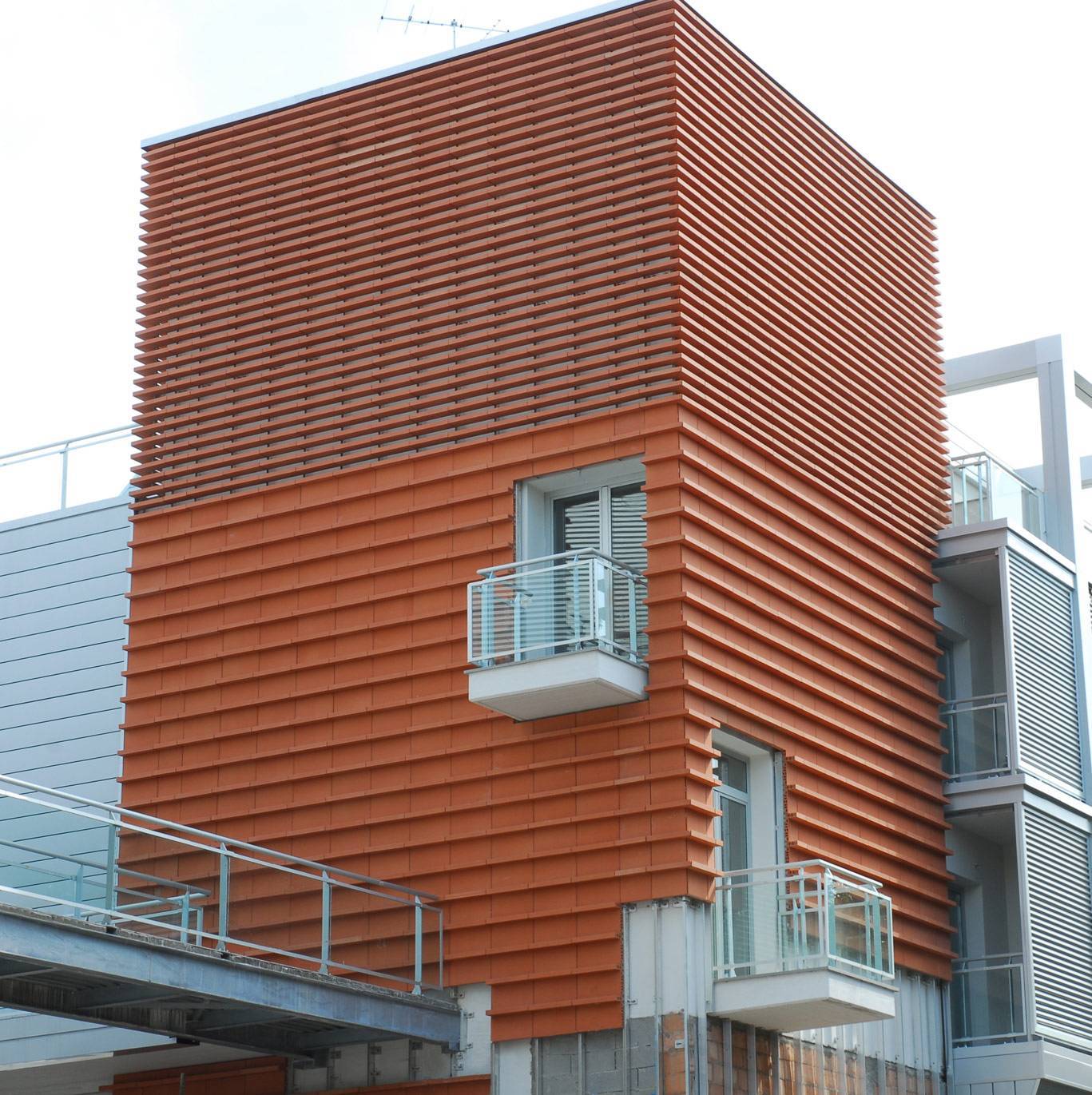
What is a ventilated façade?
A ventilated façade is a cladding and protective system for external walls that combines two fundamental characteristics that are normally in contrast with each other:
- Protection against rainwater
- Wall breathability
A ventilated terracotta façade is designed to meet a range of essential requirements and performance standards that contribute to optimal indoor comfort.
The ventilated façade is also characterised by a “dry” construction system, based on mechanical fixing and designed to provide a high degree of reliability.
A ventilated wall offers several advantages:
-
No maintenance is required after installation.
-
The characteristic reddish-orange colour of Impruneta terracotta gives the façade an attractive and elegant appearance.
-
Complete protection against rainwater.
-
Improved wall breathability.
-
Better protection against moisture and improved preservation of the building structure.
-
Excellent thermal insulation in both winter and summer.

PDF catalogue
Insulation without mould
A ventilated terracotta façade provides effective thermal insulation—not simply insulation that complies with legal requirements, but a system designed to prevent the defects that cause most cases of condensation and mould inside buildings. Over time, these problems can lead to cracking and detachment of sections of the façade.
7 good reasons to choose a ventilated façade
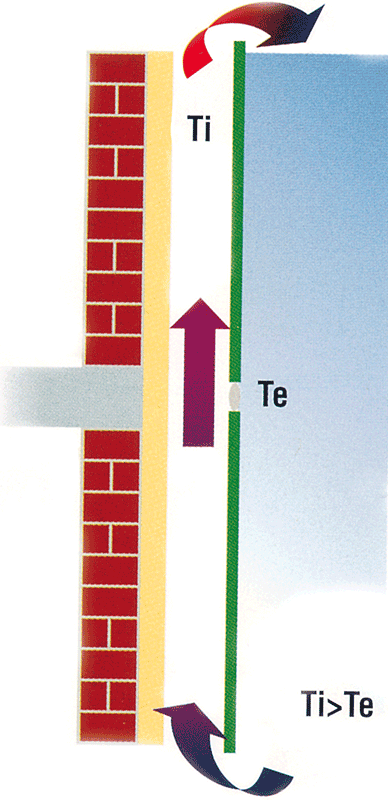
CHIMNEY-EFFECT VENTILATION
continuous outside face
The Aired Front in cotto has been always distincted by its main characteristic, namely the one, to create a “moving inner tube” between the coating wall and the external parameter of coat.
This “inner tube” can be developed with a closed connected parameter, realizing in this way an air-passage with the effect of a fireplace.
This presuppose a continuity, a well determined thickness and a height of the inner tube which not always is possibile to realize on usual building constructions; in fact, the openings, the overhangs or other constructive knots may interrup the ventilation, causing air-stagnations which reduce the favoured effect of the ventilation.
The strong moving air from the ground to the upper part, especially in the winter months, do not positively contribute in the isolation of the wall.
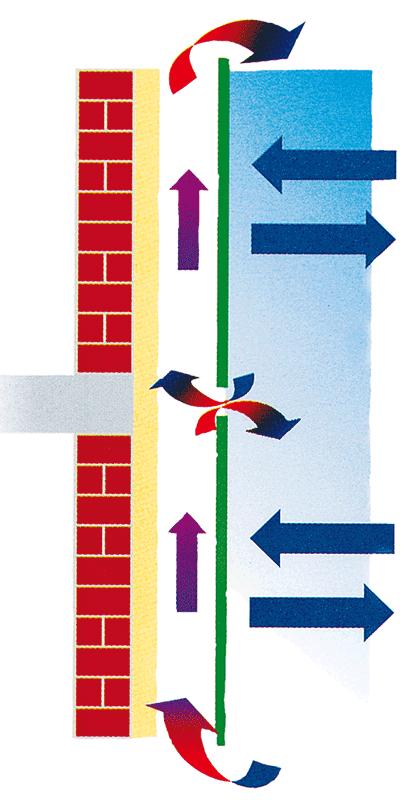
OPEN JOINT – LOCALIZED VENTILATION
Discontinuous outside face
The solution of the Aired Front in cotto with open connections“ as it’s today usually realized” is not originated only by physical considerations as for example, the theoretical behaviour of the air which is in the “inner tube” of the ventilation, but by matured experiences during the last 20 years.
During these years of maturity it was recognized as far as concerns the action in the pressure or depression of the wind, as far as concerns the heating or cooling of the air in the “innner tube of the ventilation” the circulation of air therein is certainly more regular and continous as for example in a solution with closed connections.
WATERPROOFING
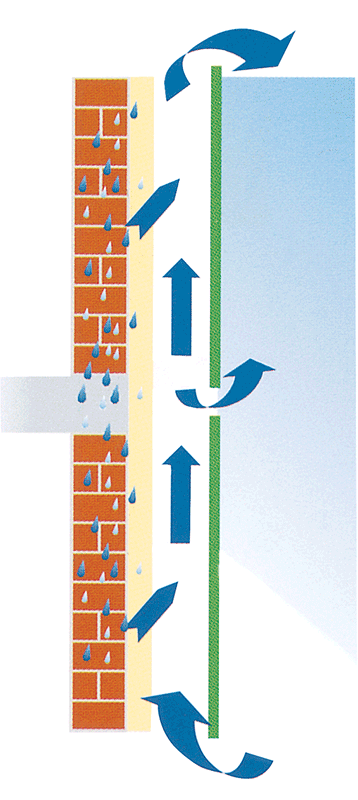
waterpoofing
With the Aired Front in cotto a protective system of the walls with high transpiration is realized because it permits, that the umidity produced in the inner rooms of the construction can – as far as possible – diffuse to the external part, without meeting obstacles or barriers. In that way, the walls and panels of the isolation stay in dry conditions and are therefore ideal for obtaining the best isolation and the best preservation of the external structures.
HEAT INSULATION
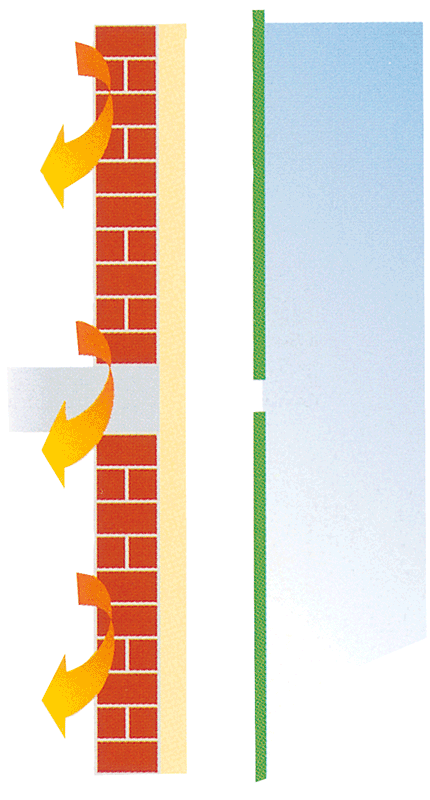
elimination points termique
With the Aired Front in cotto, it is possible to achieve proper thermal insulation, that is, insulation that not only complies with legal standards but is also free of those defects that cause most instances of condensation and mold inside homes, which over time lead to cracks and the detachment of portions of the facade.
SUMMER HEAT SHIELD EFFECT
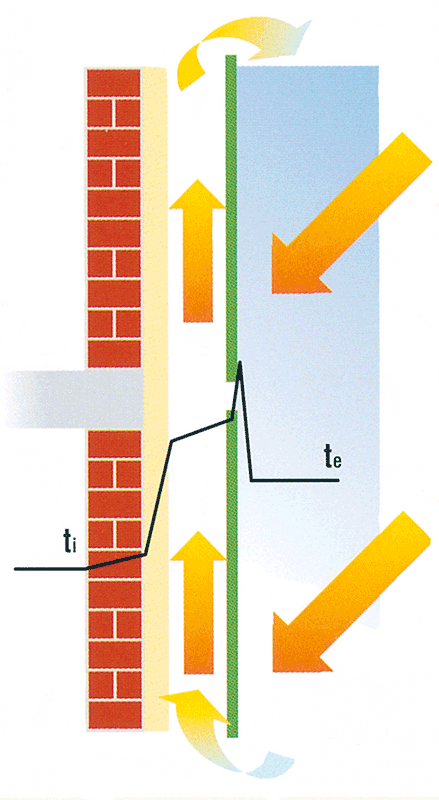
“summer heat shield” effect
During the summer time the Aired Front create a real and proper“thermic shield”in the structure where it is applicated. In this way, it is protected from the high level of heath, particularly on the walls of the western and southern side.
HEAT INERTIAL
area proportional to heat capacity
With theAired Front it is possible to produce habit walls with a high thermic inertia which means that the thermic capacity of the walls in the summer can be utilized.
Displacement of the heath-wave, namely the heath enter in the inner of the lodging, not only in a reduced way, but also during the hours when the spere-temperature is not so high and during winter conditions when the walls need more time for cooling.
NOISE REDUCTION
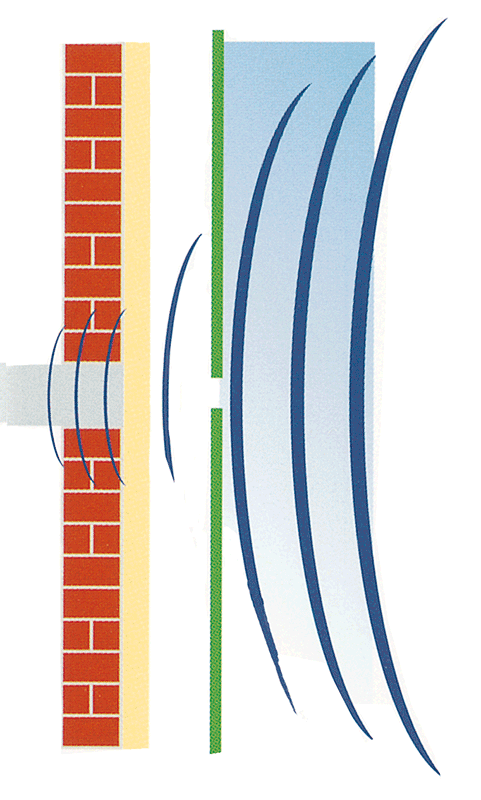
Noise reduction
With a ventilated facade, it is easy to comply with legal requirements regarding sound insulation (Framework Law 447), as it is a multi-layered composite system and therefore more effective at absorbing noise.